
Solar panels (modules)
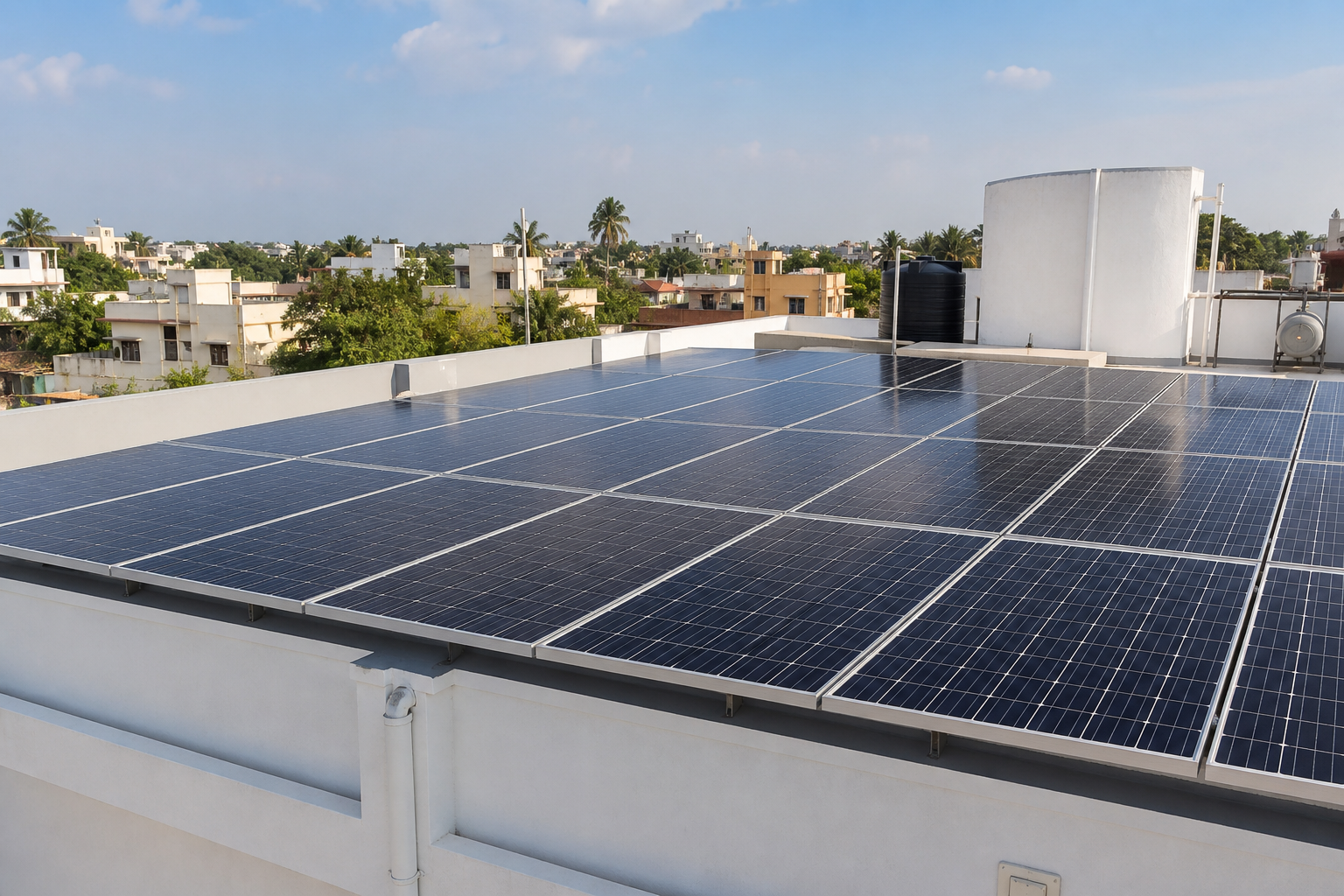
Mounted on the roof facing sun (usually south in India). Roughly 1 kW needs about 8–10 m² of clear roof, depending on panel type and spacing.
Homeowner guide
Plain explanation for families who want lower electricity bills — panels, inverter, and net metering — not jargon for engineers.
Solar panels on your roof turn sunlight into DC electricity. An inverter converts it to AC for your home. When you generate more than you use, the extra units go to the DISCOM grid (APSPDCL in much of Andhra Pradesh, TGSPDCL in much of Telangana) through a bi-directional (net) meter. When you need more than you generate (evening, cloudy day), you draw from the grid as usual.
Most homes under PM Surya Ghar use on-grid systems — no big battery required. You stay connected to the grid and your bill reflects units imported minus units exported (as per DISCOM rules).
Main parts
Mounted on the roof facing sun (usually south in India). Roughly 1 kW needs about 8–10 m² of clear roof, depending on panel type and spacing.
Converts panel DC to household AC. For subsidy, equipment should follow MNRE / ALMM rules via an empanelled vendor.
APSPDCL or TGSPDCL installs a bi-directional meter after inspection. This is what links your plant to billing and subsidy commissioning.
Night: Panels produce nothing. You use grid power. Your daytime surplus (if any) has already reduced what you owe over the billing cycle under net metering.
Cloud / rain: Generation drops but does not stop completely on light overcast. Annual estimates already assume real weather — not perfect sun every day.
Power cut: Standard on-grid systems shut down for safety (they must not feed a dead grid). They do not give backup like a battery/inverter home UPS unless you add a hybrid system — which is a different product and usually outside the simple subsidy path.
An installer measures shade and structure on site. Our online check only answers the money question first.
| Monthly bill (approx.) | Often discussed size | Roof (ballpark) |
|---|---|---|
| ₹1,500 – ₹2,500 | 2 kW | ~16–20 m² |
| ₹2,500 – ₹4,000 | 3 kW | ~24–30 m² |
| ₹4,000+ | 4–5 kW | ~35–50 m² |
Subsidy for residential central CFA caps in a way that 3 kW often hits the ₹78,000 ceiling — larger plants can still make sense on high bills, but extra kW do not increase that central cap.